
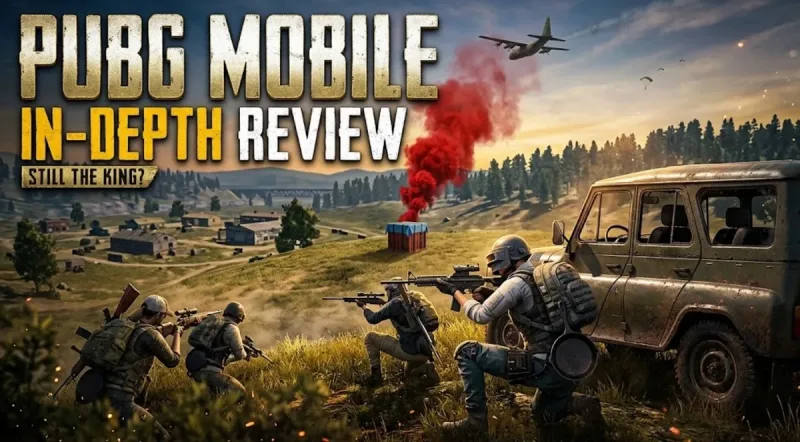
Few mobile games have altered the global gaming landscape quite like PlayerUnknown’s Battlegrounds Mobile (PUBG Mobile). When Lightspeed & Quantum and Krafton compressed a brutally demanding PC tactical shooter down to an Android and iOS application, skepticism was everywhere. Touchscreens felt too clunky for millimeter-precise snipes, and phone hardware wasn't supposed to render wide-open 8x8 kilometer landscapes without turning your battery into a molten hand-warmer.
Years later, PUBG Mobile is not just surviving; it remains the baseline against which every competitive handheld shooter is measured. But behind the collabs, the neon weapon cosmetics, and the dizzying seasonal events, how does the actual game hold up today?
Whether you are contemplating jumping into your first hot-drop or thinking about returning after years away, here is an unfiltered, boots-on-the-ground breakdown of how PUBG Mobile actually plays.
The Core Loop: Pure Tactical Tension
At its core, PUBG Mobile follows the pure, unadulterated battle royale formula: 100 players board a cargo plane, parachute unarmed over a sprawling island, scavenge for firearms and medical gear, and fight to be the last squad standing as an electric blue zone chokes the playable area inward.
What differentiates PUBG Mobile from arcade titles like Call of Duty: Mobile or hero shooters like Free Fire is its deliberate, punishing pacing. You don't have infinite sprint slides, grappling hooks, or instant self-revive abilities. Every movement has friction, weight, and consequence:
-
The Scavenge Phase: Dropping into high-tier loot zones (like Pochinki, Georgopol, or the Military Base) means frantic, high-heartbeat brawls where an opponent getting an UZI before you find a shotgun means an immediate trip back to the lobby.
-
The Mid-Game Rotation: Surviving the early scrap transitions into vehicular rotations, clearing compounds, and reading the terrain. Holding high ground on a hill or ambushing a squad at a choke-point bridge yields pure tactical satisfaction.
-
The Final Circle: When the zone shrinks to a tiny patch of wheat field or a cluster of rocks, the game shifts from gun-running into psychological horror. Every bush could hold a prone player ("snake"), every footstep sound tick gives away a flank, and one ill-timed smoke grenade can ruin your cover.
The tension never feels synthetic. When you finally claim that "Winner Winner Chicken Dinner," the adrenaline dump feels earned because you survived 25 to 30 minutes of lethal variables.
Gunplay, Ballistics, and Recoil Mechanics
If the shooting mechanics felt loose or floaty, PUBG Mobile would have died long ago. Instead, it boasts some of the most intricate gun physics ever engineered for mobile screens.
Realistic Ballistics
Bullets in PUBG Mobile are physical projectiles, not hitscan rays. That means two critical mechanics govern every gunfight:
-
Bullet Drop: Firing a bolt-action sniper rifle like the Kar98k or M24 at a target 300 meters away requires you to aim slightly above the helmet to account for gravity.
-
Bullet Velocity & Travel Time: Moving targets demand leading your crosshair. An AWM chambered in .300 Magnum flies flatter and faster than a 7.62mm round, rewarding players who memorize individual weapon velocities.
Recoil Patterns & Spray Control
Every weapon carries distinct horizontal and vertical kick profiles:
-
5.56mm Rifles (M416, SCAR-L, AUG): Predictable, stable, and forgiving. Fully kitted with a compensator, vertical foregrip, and tactical stock, an M416 with a 3x or 4x scope allows lethal mid-range laser sprays.
-
7.62mm Heavy Hitters (Beryl M762, AKM): Violently erratic. They deliver catastrophic close-quarters damage, but if you don't aggressively drag your thumb down or tilt your phone, your muzzle climbs straight into the clouds after five bullets.
-
SMGs & Shotguns: Weapons like the Vector, UMP45, and DBS dominate tight indoor angles. The limb-damage multipliers on SMGs mean you can shred enemies even if they are wearing Level 3 vests.
The skill ceiling here is massive. Mastering attachments, understanding reload cadences, and switching between single-tap and full-auto fire separates casual hobbyists from tournament-tier fraggers.
Touch Controls, Gyroscope, and the "Claw" Revolution
Playing a competitive shooter on glass should be miserable, yet PUBG Mobile offers arguably the most granular control customization in mobile gaming history.
The Rise of the Gyroscope
For serious players, Full Gyroscope (Always On) is mandatory. Instead of dragging your right thumb down across the screen to fight recoil, you physically tilt your device forward. Gyroscope grants surgical micro-adjustments for tracking running targets, flicking crosshairs between doorways, and locking onto heads during full-auto sprays.
Granular Sensitivity Tuning
The settings menu looks like an engineering dashboard. You can customize:
-
Camera sensitivity per optic (No Scope, Red Dot, 2x, 3x, 4x, 6x, 8x).
-
ADS (Aim Down Sight) drag sensitivity independent of free-look.
-
Gyroscope tracking multipliers.
-
Left/Right lean modes (Hold, Tap, or Mixed).
This depth allows players to eliminate physical barriers. A dedicated four-finger claw player with calibrated gyroscope settings can track targets with accuracy rivaling a mouse-and-keyboard setup.
Map Dynamics: Erangel to Nusa
PUBG Mobile avoids monotony by offering distinct battlegrounds tailored to different playstyles and session lengths:
| Map | Size | Terrain Style | Match Pace | Recommended Strategy |
| Erangel | 8x8 km | Eastern European plains, forests, towns | Balanced (25–30 min) | Compound holding, bridge camping, balanced rifle/sniper loadouts. |
| Miramar | 8x8 km | Open desert, steep ridges, abandoned factories | Slow, tactical (30 min) | Long-range marksmanship, vehicular rotations, ridge-line peek battles. |
| Sanhok | 4x4 km | Tropical jungle, rain, ruins, dense foliage | Fast, aggressive (18–22 min) | Close-quarters SMG/AR combat, rapid flank checks, anti-snake awareness. |
| Livik | 2x2 km | Nordic waterfalls, hot springs, snowfields | Fast-paced (12–15 min) | Continuous skirmishing, utilizing monster trucks, instant action. |
| Karakin | 2x2 km | Arid hills, underground tunnels, destructible walls | High octane (10–12 min) | Wall-breaching with sticky bombs, dodging the demolition black zone. |
| Nusa | 1x1 km | Tropical resort, zip lines, elevators | Lightning fast (8–10 min) | Immediate drops, rapid looting, aggressive short-range rush. |
Erangel remains the undisputed holy grail—a masterclass in sightline management and pacing. Meanwhile, maps like Livik and Nusa cater to the modern mobile gamer who wants tactical gunfights during a 15-minute commute without committing half an hour to an open-desert trek.
Audio Design: Your Primary Survival Tool
You cannot play PUBG Mobile effectively through phone speakers at low volume. Audio engineering is not decorative here; it is your primary radar.
-
Directional Soundscapes: Footsteps vary audibly depending on the surface—wood floors in a Pochinki apartment sound sharp and hollow, mud sounds sluggish, metal roofs ping under weight, and water splashes loudly.
-
Vertical Audio Awareness: Experienced players can pinpoint whether an enemy is on the roof, creeping up the wooden staircase, or crouching outside a ground-floor window just by listening to footsteps.
-
Combat Signatures: You can distinguish the crack of distant gunfire from the whiz of a bullet passing your head. The metallic pin click of a frag grenade being cooked around a corner tells you to jump out of a window immediately.
Using a stereo headset with low latency is virtually mandatory if you intend to climb past Gold tier.
Performance, Graphics, and Device Demands
Visually, PUBG Mobile remains impressive due to its Unreal Engine 4 foundation. Weather transitions, vehicle dust clouds, scope reflections, and water shaders look remarkably crisp.
The Performance Golden Rule
Almost all high-tier players use Smooth Graphics paired with the highest available Frame Rate setting (Extreme, 90 FPS, or 120 FPS). Running at "Ultra HD" looks pretty, but shadows obscure proned enemies in the grass, and heavy rendering introduces thermal throttling and frame drops during intense final-circle smoke barrages.
Hardware Reality Check
-
Flagship Devices: Phones sporting modern flagship processors chew through 90 or 120 FPS without breaking a sweat, provided ambient temperatures don't cook the chassis.
-
Mid-Range & Budget Phones: Can easily hold a stable 45 to 60 FPS on "Smooth" settings.
-
Thermal Throttling & Battery Drain: A continuous two-hour session will drain your battery fast. Investing in a budget clip-on smartphone cooling fan is one of the best quality-of-life upgrades for keeping frame rates rock steady.
The Elephant in the Room: Monetization and Visual Clutter
No honest review of PUBG Mobile can ignore its monetization model. The game is free-to-play, and from a mechanical standpoint, it is not pay-to-win. You cannot buy ammunition that hits harder, armor with extra health, or scopes that zoom further. A naked player with an UZI found on the floor can eliminate a player wearing a $1,000 outfit.
However, the cosmetic economy is aggressive:
-
Gacha Crates & Lucky Spins: Upgradable gun skins (like the Glacier M416) feature custom kill broadcasts, loot crate appearances, and on-hit sparks. Unlocking and fully maxing these skins through "Materials" and "Paint" can demand hundreds of dollars in real money.
-
Visual Identity Drift: PUBG began as a gritty, military-sim tactical battle royale. Today, the lobby is filled with neon sports cars, anime crossovers, glowing mythic wings, and mascot suits.
-
Storage Footprint: While the core client is modest, downloading all resource packs, high-resolution textures, maps, and audio packs pushes the game's footprint past 15 to 20 GB on your internal storage.
If you can ignore the barrage of pop-up event banners when you open the main menu, the core competitive gameplay remains uncompromised.
Matchmaking, Rank Grind, and Bot Distribution
For newcomers, your first ten matches will feel ridiculously easy. That is because low ranks (Bronze through Silver) are heavily populated by computer-controlled bots designed to teach basic mechanics without frustration.
Once you climb into Crown, Ace, and the upper echelon of Conqueror, the training wheels come off completely. Matchmaking turns into a brutal, fast-paced arena where:
- Squads communicate via low-latency voice chat.
- Smoke grenades are deployed with surgical timing.
- Snipers hit moving headshots through 4x scopes across valleys.
- A single mistake wipes your squad and docks precious rating points.
The anti-cheat system (Ban Pan) has improved significantly over the years, deploying real-time telemetry analysis, behavioral bans, and replay reviews. While cheaters occasionally pop up at the start of new competitive seasons, the vast majority of matches feel clean and balanced.
Comprehensive Pros and Cons
| What Makes It Great (Pros) | Where It Stumbles (Cons) |
| Unmatched Ballistics: Authentic weapon recoil, bullet velocity, and drop physics. | Heavy Storage Footprint: Full resource packs demand upwards of 18–20 GB of storage. |
| Elite Controls: Industry-leading customization with full gyroscope support. | Aggressive Microtransactions: Gacha wheels, lucky spins, and expensive cosmetic skins. |
| Map Diversity: Six battle royale maps catering from tactical marathons to 10-minute skirmishes. | Cluttered UI: Daily pop-ups, spin banners, and notification badges crowd the lobby. |
| Competitive Esports Scene: Thriving global tournaments, active clans, and deep rank ladders. | Early Bot Saturation: Can feel deceptively simple to beginners until reaching higher ranks. |
| True Free-to-Play: Zero pay-to-win stats; pure skill and positioning dictate outcomes. | Thermal Demands: High frame rate sessions cause noticeable battery drain on older phones. |
The Final Verdict
Score: 8.8 / 10 — The Gold Standard for Handheld Battle Royales
Despite flashy monetization and an expanding file size, PUBG Mobile remains the absolute pinnacle of tactical mobile shooters. It respects the player's intelligence by demanding real spatial awareness, map knowledge, recoil discipline, and calculated decision-making.
It does not hold your hand. If you expose your helmet behind a ridge on Miramar, an AWM round will end your match instantly. But when you orchestrate a four-man compound breach, coordinate smoke lines across an open field, and take down the final enemy squad under heavy fire, no other game on a smartphone delivers that same visceral rush.
If you have a modern device, a pair of earphones, and a willingness to master the learning curve, PUBG Mobile is still worth every gigabyte.