
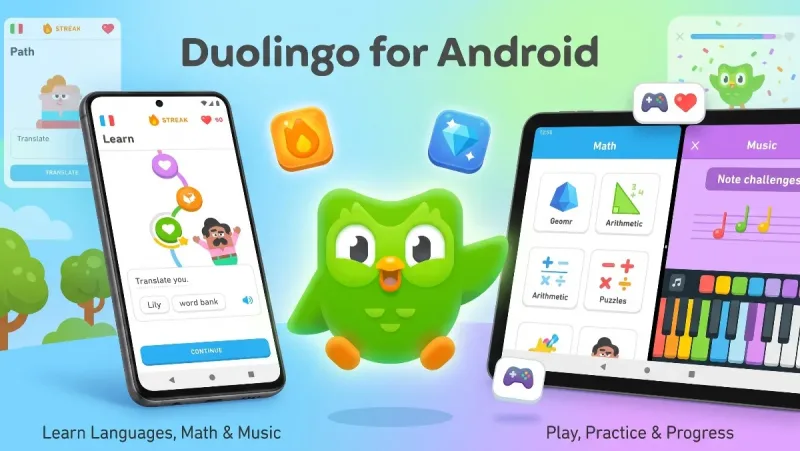
If you have spent even five minutes contemplating learning a new language over the past decade, you have crossed paths with Duo the Green Owl. He has threatened to cry outside your window, guilt-tripped you via push notifications at 11:45 PM, and turned the simple act of reviewing Spanish verbs into a high-stakes dopamine chase.
With well over 500 million downloads on Google Play, Duolingo is undisputed king of mobile education. But popularity does not automatically equal fluency. Over the years, the application has evolved from a crowdsourced translation project into an entertainment-heavy, algorithmically driven mobile ecosystem. It now packs Math, Music, and Chess into the same package, while layering generative AI over its premium tiers.
For anyone wondering whether tapping word tiles on their commute can genuinely teach them a foreign language, this in-depth Duolingo android apps review breaks down real-world teaching mechanics, the gamified progression path, tier pricing, AI additions, and the honest limits of the app.
The Learning Interface: The Linear Learning Path
Duolingo abandoned its classic sprawling "Tree" structure in favor of a single, scrolling linear track: The Path.
Instead of choosing whether you want to tackle clothing vocabulary, past-tense verbs, or food adjectives, the app moves you along an automated conveyor belt. Each circular node represents a focused micro-lesson containing interactive translation cards, listening drills, matching challenges, and voice recognition prompts.
Bite-Sized Cognitive Drills
Lessons are explicitly calibrated for mobile attention spans, taking between two and four minutes to finish:
-
Word Banking: Arranging scrambled blocks into coherent sentences.
-
Rapid Pairing: Connecting target vocabulary to native translations against a ticking timer.
-
Audio Dictation: Listening to high-pitched, slow, or conversational dialogue and typing what you hear.
-
Pronunciation Feedback: Repeating spoken phrases into your Android device's microphone.
The experience is visually polished. Animations are snappy, the tactile haptics trigger crisp feedback on correct answers, and the cast of quirky animated characters—from sulky teen Lily to dramatic Bea—keep the screen feeling alive.
Gamification: Habit Machine or Addictive Distraction?
Duolingo's greatest triumph is not linguistic pedagogy; it is behavioral psychology. If traditional textbooks fail because learners give up after three weeks, Duolingo succeeds by refusing to let you leave.
The Streak Mechanic
The core of the experience is the daily streak counter. Seeing an unbroken number like "Day 412" triggers genuine loss aversion. To preserve it, you will open the app in airport security lines, on packed trains, and moments before falling asleep. The app provides streak freezes (purchasable with in-game gems) to give you emergency breathing room, but the psychological tether remains absolute.
Weekly Leagues & Leaderboards
Every completed exercise generates XP (Experience Points). You are sorted into 30-person weekly divisions ranging from Bronze up to Diamond League. If you drop into the bottom tier of your division by Sunday evening, you are demoted.
While competitive leaderboards spur massive activity, they also distort learning intent. Users looking to stay afloat in the Diamond League often replay effortless early lessons, farm lightning rounds, or burn double-XP potion boosts instead of advancing toward harder, unfamiliar grammar concepts.
The Free Experience: Hearts, Energy, and Ads
Understanding Duolingo on Android requires addressing the financial wall separating free users from paying subscribers.
The Heart / Energy System
In the free tier, mistakes have direct consequences. You begin each day with five hearts. Every erroneous translation or spelling error docks one heart. Lose all five, and you are locked out of normal lesson progression until your hearts recharge over several hours—unless you watch rewarded video ads, spend accrued gems, or grind through review modules in the Practice tab.
In recent iterations and test builds, Duolingo has tightened this monetization loop through an Energy pool, placing caps on daily free sessions even for high-accuracy learners. For casual daily practice, the free tier works well; for an ambitious learner hoping to study 45 minutes every evening, the free setup can feel punishingly restrictive.
Paid Tiers: Super Duolingo vs. Duolingo Max
To strip away limitations, Duolingo provides two distinct subscription upgrades:
| Feature | Free Tier | Super Duolingo | Duolingo Max |
| Lesson Access | Standard Path | Standard Path | Standard Path |
| Hearts / Health | 5 Hearts (Limited) | Unlimited | Unlimited |
| Advertisements | Full-screen video ads | Completely Ad-Free | Completely Ad-Free |
| Practice Hub | Basic mistake review | Target Mistake Bank | Target Mistake Bank |
| Explain My Answer | ❌ None | ❌ None | AI Grammar Breakdown |
| Roleplay / Video Call | ❌ None | ❌ None | Interactive AI Dialogues |
Is Super Duolingo Worth It?
Super Duolingo removes the anxiety of getting penalized for trying. With unlimited health, you can experiment with unfamiliar sentence constructions without fearing an immediate lock-out. If you are serious about using the app daily for more than 10 minutes, the family tier split among friends or relatives provides strong value simply by eliminating full-screen commercial interruptions.
The AI Frontier: Duolingo Max
Duolingo Max sits at the top of the price ladder, integrating customized GPT-powered tutoring directly into your lessons:
-
Explain My Answer: When you pick an incorrect preposition, you can tap a button to read an instant AI-generated breakdown explaining why the answer was wrong and the grammar rule behind it.
-
Roleplay & Video Calls with Lily: Simulates spontaneous conversational practice. You engage in back-and-forth verbal or text exchanges—such as ordering food at a Parisian bistro or returning clothes to a market vendor. While useful as low-stakes speaking warm-ups, calls are intentionally short (often lasting only 1 to 2 minutes before reaching a scripted conclusion), meaning they cannot replace speaking with an actual human tutor.
Beyond Languages: Math, Music, and Chess on Android
Duolingo is actively transforming itself from a language specialist into a unified educational hub. Through the switcher at the top of the app, Android users can toggle between distinct subjects:
-
Duolingo Math: Focuses on mental arithmetic, fraction visualization, geometric angles, and everyday math calculations through rapid gamified puzzles.
-
Duolingo Music: Uses a virtual piano keyboard directly on your screen to teach rhythm, treble and bass clef sight-reading, and note identification using short musical loops.
-
Duolingo Chess: Breaks down opening tactics, piece mobility, checkmate patterns, and spatial calculations into puzzle-sized chunks.
While none of these replace conservatory training or a competitive chess club, they make foundational cognitive drills fun and accessible on public transit.
Where Duolingo on Android Falls Short
No comprehensive Duolingo android apps review would be complete without addressing the limitations of the platform's core educational model:
1. Course Asymmetry
Duolingo’s top-tier courses—specifically Spanish, French, German, and Japanese for English speakers—are packed with rich audio, podcasts, and deep CEFR-aligned content reaching up to intermediate B2 competencies.
However, secondary courses (such as Hindi, Arabic, Gaelic, or Swahili) often feel neglected. They lack conversational stories, feature robotic synthetic text-to-speech, and offer sparse grammatical explanations, leaving learners to guess rules entirely by pattern recognition.
2. The Illusion of Fluency
Duolingo excels at vocabulary recognition, basic reading comprehension, and low-level listening. However, choosing word bubbles from a neatly sorted tray of options is vastly different from formulating an unassisted sentence in a noisy café.
The app rarely forces you to produce target language from an entirely blank mental canvas. Consequently, many users maintain multi-year streaks yet seize up when asked a basic spontaneous question by a native speaker.
3. Sparse Grammar Guidance
Duolingo relies heavily on implicit learning: exposing you to patterns until your brain catches on. While this mimics natural childhood acquisition, adult brains benefit significantly from explicit rules: "This verb is irregular because of X; this case changes the direct object ending to Y." Without Duolingo Max's AI explanations or external reference books, you will often find yourself confused by recurring case endings.
How Duolingo Compares to Android Rivals
To see where Duolingo sits in the wider digital language ecosystem, consider how it stacks up against its main alternatives on Google Play:
-
vs. Babbel: Babbel provides superior, classroom-style grammar instruction and authentic dialogue scenarios. It feels less like a video game and more like a structured digital textbook. However, it lacks Duolingo's viral motivational streak features and free tier.
-
vs. Busuu: Busuu incorporates structured lessons aligned with official CEFR standards and lets native speakers from the community critique your written and audio exercises. It bridges the gap between Duolingo's gamification and formal linguistic study.
-
vs. Pimsleur: Pimsleur focuses almost exclusively on conversational audio, making it far superior for verbal speaking cadence and listening comprehension, though it lacks Duolingo's engaging visual puzzles.
Practical Tips to Maximize Duolingo on Android
If you use the app, make these tactical changes in your settings to double your retention:
-
Speak Every Sentence Aloud: Do not simply read the target sentence quietly in your head before selecting the answer. Pronounce every prompt out loud to build physical muscle memory in your vocal cords.
-
Turn Off Word Banks When Possible: On reading and translation prompts, switch to the manual keyboard input toggle whenever available. Forcing your brain to recall letters, spelling, and accents without hints vastly increases retention.
-
Ignore the Leagues if They Cause Stress: If you find yourself farming easy XP solely to stay in the Diamond League, turn your profile to "Private" on the web dashboard. This removes you from leaderboards entirely, allowing you to focus on difficult units without feeling pressured by points.
-
Use It as a Supplement, Not an Island: Treat Duolingo as an introductory warm-up. Combine it with graded reader novels, target-language podcasts, YouTube language channels, and real conversation apps like iTalki or HelloTalk.
The Final Verdict
Completing this Duolingo android apps review reveals an app that is unmatched at building habits, even if it cannot take you across the finish line of complete conversational fluency.
Duolingo will not make you fully bilingual on its own. It will, however, build a daily foundation of vocabulary, familiarize your ears with foreign sentence patterns, and keep you engaged with a new language long after traditional methods would have gathered dust on a bookshelf.
As a free or low-cost daily habit builder, Duolingo for Android remains the most fun, accessible entry point into the world of languages available on your smartphone. Just remember that the green owl is your coach for warming up—not the entire game.




Comments
No comments yet. Be the first to ask a question or share an update.
Leave a comment
Your mobile number is never published. Comments appear after review. Website links, email addresses and code are not allowed.