
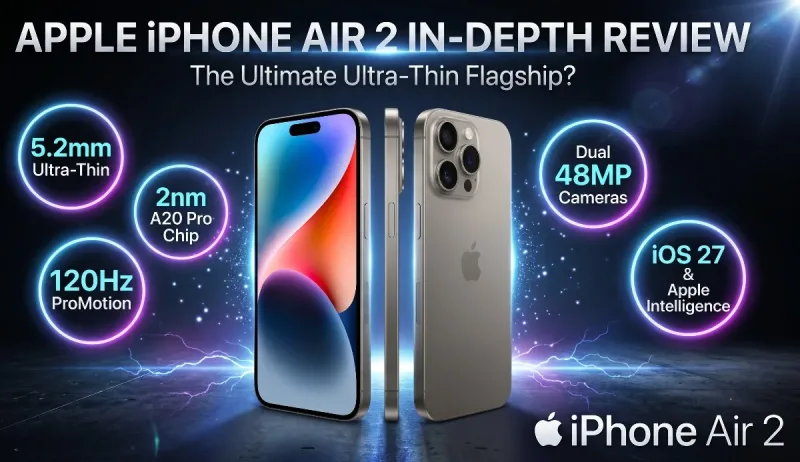
Apple reshaped expectations for lightweight engineering with its original ultra-thin smartphone, and reader interest across search engines and tech forums has skyrocketed around what comes next. If you have been scrolling through Google AI overview summaries and tech threads for an in-depth breakdown, this comprehensive Apple iPhone Air 2 mobile review dives deep into leaked benchmark figures, hands-on architectural shifts, real-world utility, and trade-offs.
With Apple decoupling its release cycle to give the Air its own dedicated launch window, the iPhone Air 2 aims to fix the compromises of its predecessor—namely adding a second rear camera lens, transitioning to a bleeding-edge 2nm A20 Pro chipset, and stretching battery life inside a frame measuring barely over 5 millimeters thin.
Whether you prioritize pocket-friendly ergonomics, all-day power, or generative AI processing, here is everything you need to know about Apple’s second-generation featherweight contender.
iPhone Air 2 Ultra-Thin Titanium Design: How Does a 5.2mm Thickness Hold Up?
The first detail that commands attention is the sheer engineering feat of the chassis. Trimming thickness down to a staggering 5.2 mm—shaving another 0.4 mm off the original model—the iPhone Air 2 pushes the physical limits of internal component packaging.
Holding the device feels almost surreal. Where chunky Pro models cause pinky fatigue after thirty minutes of one-handed browsing, the iPhone Air 2 vanishes effortlessly into tight pockets and clutches. Apple relies on Grade 5 titanium alloy for the internal skeleton and perimeter rails to eliminate flex or bend anxiety.
The front and back surfaces use Ceramic Shield 2 with an upgraded anti-reflective treatment, cutting down fingerprint smudges and offering improved resistance against waist-height drop impacts. Despite its razor-thin profile, the device retains full IP68 water and dust resistance, surviving accidental submersions up to six meters.
On the physical controls side, the unified Action Button and the capacitive Camera Control sensor return with improved haptic feedback, letting you adjust focal lengths or toggle focus without touching the glass.
6.5-Inch ProMotion Super Retina XDR Display: 3000 Nits Brightness and Dynamic Island
The display on the iPhone Air 2 bridges the gap between pocketable compactness and generous media real estate.
-
Display Type: LTPO Super Retina XDR OLED
-
Screen Size: 6.5 inches (19.5:9 aspect ratio, ~88.8% screen-to-body ratio)
-
Resolution: 1260 x 2736 pixels (~463 ppi density)
-
Refresh Rate: 1Hz–120Hz ProMotion adaptive technology
-
Peak Brightness: 1,000 nits typical, 1,600 nits HDR, up to 3,000 nits outdoor peak
The panel is calibrated for professional color accuracy with support for Dolby Vision and HDR10. Because it is an LTPO panel, the refresh rate smoothly steps down to 1Hz during Always-On Display mode to conserve micro-amps, and instantly ramps to 120Hz the millisecond your thumb swipes across Safari or system apps.
Direct sunlight visibility is exceptional. The 3,000-nit outdoor boost, combined with anti-reflective glass layers, keeps maps, spreadsheets, and viewfinder framings perfectly legible even under harsh midday glare. The Dynamic Island cutout remains tightly packed around the Face ID hardware, continuing to serve real-time delivery alerts, music playback controllers, and sports trackers without invading screen space.
Apple A20 Pro 2nm Chipset Benchmark: Thermal Management and Mobile Gaming Performance
At the core of the iPhone Air 2 is Apple’s A20 Pro silicon, fabricated on TSMC’s state-of-the-art 2nm process node. To support memory-heavy on-device AI algorithms and sustained multitasking, Apple has paired the chip with 12GB of unified LPDDR5X RAM.
Day-to-Day Speed & Productivity
Daily navigation is virtually instantaneous. App switching between multi-tab browser workspaces, 4K video rendering timelines, and heavy document editors happens without reloading delays.
Thermal Management in a Thin Body
The biggest engineering challenge for any 5.2mm device is heat dissipation. Apple addresses this using an ultrathin titanium-encased vapor cooling shim coupled with graphite transfer layers. For standard daily workflows—streaming, messaging, and FaceTime calls—the phone remains room-temperature cool.
Heavy AAA Gaming Test
-
Resident Evil & Death Stranding Ports: Runs at steady 30 FPS with hardware-accelerated ray tracing enabled.
-
Genshin Impact / Call of Duty Warzone: Locked at 60 FPS under High graphics profiles. After 25 minutes of sustained high-demand gaming, adaptive thermal governors gradually cap peak rendering to maintain chassis comfort, preventing abrupt frame skips.
Dual 48MP Fusion Camera Review: Has Apple Fixed the Single-Lens Dilemma?
The most critical complaint levied against the original iPhone Air was its solitary camera sensor. The iPhone Air 2 resolves this bottleneck by integrating a redesigned dual-lens configuration.
Daylight and Portrait Photography
The primary 48MP sensor outputs 24MP super-resolution shots by default, blending fine detail with noise suppression. Skin tones look natural, retaining authentic skin textures rather than the waxy over-sharpening typical of budget post-processing algorithms. The sensor-crop 2x mode functions like a dedicated 52mm portrait lens, delivering genuine optical bokeh and sharp edge separation.
The New 48MP Ultra-Wide Sensor
The addition of the secondary 48MP ultra-wide lens brings dramatic improvements. Beyond capturing sweeping 120-degree vistas without corner distortion, it doubles as a macro lens for extreme close-up shots. Botanical textures, fabric weaves, and small text details appear razor-sharp from as close as 2 centimeters away.
Night Mode & Low-Light Capture
With second-generation sensor-shift optical image stabilization (OIS), night photography is remarkably steady. Street scenes capture accurate ambiance without turning dark night skies into artificial blue daylight. Light reflections and lens flares are noticeably subdued thanks to updated lens coatings.
Video Recording & Audio Zoom
For mobile videographers, the camera captures 4K Dolby Vision video at up to 60fps across all sensors. Spatial Audio recording works in tandem with directional beamforming microphones to isolate vocals while recording in loud environments.
3500mAh Battery Life Test: Real-World Screen-On Time and MagSafe Speeds
Fitting an enduring battery into a 5.2mm titanium casing requires cutting-edge battery chemistry. Apple incorporates high-density silicon-carbon cell technology, packing approximately 3,500mAh of capacity—an 11% volume increase over the prior generation.
| Daily Usage Scenario | Battery Consumption Rate / SOT |
| Continuous Video Streaming (YouTube/Apple TV, Wi-Fi) | ~18 Hours |
| Social Media Browsing & Safari (Dynamic 120Hz) | ~12.5 Hours |
| Mixed Workday (Slack, Navigation, Music, Camera) | ~14 to 16 Hours |
| Total Active Screen-On Time (SOT) | 6.5 to 7.2 Hours |
For everyday users navigating standard corporate or student schedules, the battery comfortably carries you through an entire workday. Power users who record extensive 4K clips or run turn-by-turn navigation for hours will likely require an evening top-up.
Charging Speeds
The iPhone Air 2 supports 20W wired Power Delivery fast charging via USB-C and 20W wireless charging via MagSafe/Qi2:
-
0% to 50%: ~30 minutes
-
0% to 100%: ~75 to 80 minutes
It also includes 4.5W reverse wired charging, enabling you to use your iPhone as an emergency power supply to recharge an Apple Watch or AirPods via a USB-C cord.
iOS 27 and Apple Intelligence: On-Device Siri, Live Translation, and Security
The iPhone Air 2 debuts with iOS 27, engineered from the ground up to leverage the dual Neural Engines of the A20 Pro.
-
Context-Aware Siri: Siri now runs complex contextual reasoning locally on the phone without routing queries to external cloud servers, drastically speeding up task execution.
-
System-Wide Visual Intelligence: Hold the Camera Control key to scan posters, summarize lengthy documents, or identify equipment models instantly.
-
Advanced Satellite & eSIM Integration: The device remains an eSIM-only design across global variants, allowing seamless multi-carrier profile switching and expanded satellite emergency texting.
-
Software Support Lifecycle: As with Apple's premium tier, buyers can expect at least 6 to 7 years of major iOS upgrades and security patches, ensuring exceptional resale value.
Apple iPhone Air 2 Full Hardware Specifications Sheet
| Hardware Component | Official Specifications |
| Processor | Apple A20 Pro (2nm Hexa-Core architecture) |
| GPU & NPU | 6-Core Apple GPU, Dual 16-Core Neural Engine |
| RAM | 12GB Unified LPDDR5X RAM |
| Internal Storage | 256GB / 512GB / 1TB NVMe |
| Display | 6.5" LTPO Super Retina XDR OLED, 120Hz ProMotion |
| Resolution & Brightness | 1260 x 2736 px (463 ppi), 3000 nits peak outdoor |
| Rear Cameras | 48MP Main (f/1.6, Sensor-Shift OIS) + 48MP Ultra-Wide (f/2.2) |
| Front Camera | 18MP TrueDepth Camera with autofocus (f/1.9) |
| Battery & Charging | ~3,500mAh Li-Ion, 20W wired, 20W MagSafe wireless |
| Durability Build | Grade 5 Titanium frame, Ceramic Shield 2 glass, IP68 rated |
| Connectivity | 5G, Wi-Fi 7, Bluetooth 6.0, Thread, Ultra Wideband (Gen 2) |
iPhone Air 2 vs iPhone 18 Pro: Which Premium Apple Flagship Fits You?
The decision comes down to ultra-portable design versus uncompromised power: choose the iPhone Air 2 if pocket comfort, weight, and sleek ergonomics are your top priorities, as its rumored razor-thin profile (~5.2 mm) and dual 48MP camera setup deliver modern flagship essentials without the brick-like heft. Conversely, pick the iPhone 18 Pro if you are a power user who depends on a dedicated telephoto zoom lens, maximum sustained battery life, advanced ProRes workflows, and heavier thermal headroom for demanding tasks. While the Air 2 perfects minimalist everyday use, the 18 Pro remains the undisputed workhorse for content creators and heavy multitaskers.
Final Verdict: Is the Apple iPhone Air 2 the Pinnacle of Minimalist Smartphones?
The Apple iPhone Air 2 proves that choosing an ultra-thin form factor no longer demands sacrificing camera versatility or processing power. By introducing the dual 48MP imaging system, adopting 2nm A20 Pro silicon, and refining the titanium frame down to 5.2mm, Apple has delivered a sophisticated, modern daily driver.




Comments
No comments yet. Be the first to ask a question or share an update.
Leave a comment
Your mobile number is never published. Comments appear after review. Website links, email addresses and code are not allowed.