
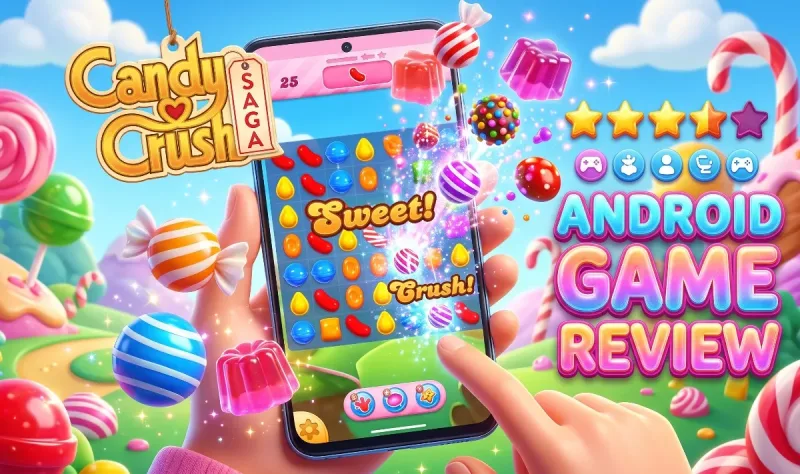
If you have spent any time in an airport terminal, a dentist’s waiting room, or on a crowded subway train over the past decade, you have heard it: the bass-heavy baritone declaring "Sweet!" or the cascading chiming sound of exploding striped jellies.
Launched on mobile platforms back in late 2012 by King (now operating under Microsoft), Candy Crush Saga did not merely capture the early wave of smartphone gaming—it defined it. But mobile gaming is notoriously fickle. Dozens of once-ubiquitous hits have vanished into digital oblivion, yet this candy-swapping juggernaut still commands millions of active daily players and billions in lifetime revenue.
Whether you are debating redownloading it for nostalgia or stepping into its sugar-coated universe for the first time, this deep-dive review explores how the Android edition holds up today.
The Core Gameplay: Deceptively Simple Mechanics
At its foundation, Candy Crush Saga belongs to the match-three tile puzzle genre popularized by classics like Bejeweled. The objective sounds elementary: swap two adjacent pieces on a grid to align three candies of the same color, causing them to pop and clear space for new candies tumbling from above.
The genius—and the hook—lies in what happens when you combine more than three:
-
Striped Candies (Match 4): Clear entire horizontal or vertical rows.
-
Wrapped Candies (T-Shape or L-Shape Match): Explode in a $3 \times 3$ radius twice, annihilating tough obstacles.
-
Color Bombs (Match 5 in a Line): Clear every single piece of a targeted candy color across the entire board.
The tactical depth emerges when you mix special candies together. Swapping a Color Bomb with a Striped Candy triggers a screen-clearing chain reaction that transforms every candy of that color into a striped explosive. These layered chain reactions create an immediate, satisfying loop of audiovisual feedback that feels punchy and rewarding.
Level Variety and Obstacle Design
A puzzle game cannot survive across thousands of levels on matching alone. King keeps the board dynamic by constantly rotating level goals:
-
Clear the Jelly: Clearing pieces over stubborn double-layered jelly tiles.
-
Ingredient Drops: Guiding cherries and hazelnuts to exit chutes at the bottom of the board.
-
Target Scores: Earning points before your limited moves expire.
-
Order Collection: Creating specific combinations of special candies under constraints.
To complicate matters, you face an army of board hazards: creeping chocolate that multiplies each turn you fail to hit it, unbreakable liquorice swirls, locked cages, and time-bomb candies ticking down to an instant game-over.
In earlier worlds, this creates genuine tactical puzzle-solving where you scan several moves ahead. In later worlds, however, the balance shifts noticeably from pure skill to board layout RNG (random number generation), where success often hinges on lucky cascade drops.
Presentation, Audio, and Android Performance
Visually, Candy Crush Saga leans heavily into glossy, saturated cartoon charm. The candy pieces have distinct silhouettes and vibrant colors, making boards easy to read at a glance even on smaller Android displays.
Visual Polish and Animations
The animations run at a buttery-smooth 60 frames per second on modern Android devices. Explosions, candy wraps, and sugar cascades trigger snappy visual effects without dragging down device performance. Even budget-friendly Android handsets handle the game effortlessly without overheating or aggressive battery drain.
Sound Design
The soundtrack features an orchestral, fairytale-esque background loop that is pleasant in short bursts, though most veteran players mute it after a few sessions. What stays memorable is the sound effects: the satisfying glass-like crunch of breaking jellies, the fizzy crackle of striped candies, and the iconic voiceover intoning "Tasty", "Divine", and "Sugar Crush".
The Free-to-Play Economy: Lives, Boosters, and Paywalls
The biggest point of friction in Candy Crush Saga has always been its monetization model. The game operates under a strict freemium blueprint:
| Feature | Mechanic | Impact on Player Experience |
| Life System | Max 5 lives; 1 lost on level failure; 30-min recharge per life | Forces session breaks unless you pay or ask friends |
| Pre-Game Boosters | Extra moves, starting color bombs, jelly fish | Gives a massive edge on notoriously difficult levels |
| In-Game Helpers | Lollipop Hammer, Free Switch | Allows manual clearing of stubborn edge pieces |
| Extra Moves Prompt | Gold Bars offered when failing with 1–2 objectives left | High psychological temptation after a narrow loss |
The "Nightmarishly Hard" Wall
As you advance past the first few hundred levels, the game introduces designated "Hard," "Super Hard," and "Nightmarishly Hard" stages. While early maps give generous move counts, advanced stages throttle your moves aggressively—sometimes down to fewer than 20 moves to clear 60+ layered jellies surrounded by chocolate.
It is entirely possible to beat the game without spending a dime; however, doing so demands extreme patience. You will frequently hit roadblocks where clearing a level requires either burning through stockpiled boosters, waiting days for lucky piece distributions, or spending real money on Gold Bars.
Social Features and Community Ecosystem
One reason Candy Crush Saga avoided obsolescence is its social integration:
-
Map Progress & Leaderboards: Syncing through a King account or Facebook lets you track friends' milestones on the world map, sparking natural rivalries.
-
Life Requests: You can send and receive extra lives from friends, bypassing the 30-minute cooldown timer.
-
In-Game Events & Tournaments: Weekly events like the "Episode Race," "Candy Cup," and seasonal collection quests offer free boosters, gold bars, and infinite-lives timers (often 30 minutes to 2 hours of unrestrained play).
These live-service events give free-to-play users consistent opportunities to bank power-ups without pulling out a credit card.
Strengths vs. Weaknesses
What Works
-
Effortless Pick-Up-and-Play: Zero learning curve; you can understand the board state in seconds.
-
Top-Tier Sensory Feedback: The cascades, sound bites, and visual celebrations deliver unmatched satisfaction.
-
Flawless Android Optimization: Quick load times, small storage footprint relative to its size, and stable offline play for offline commutes.
-
Massive Content Library: With thousands of levels and bi-weekly additions, you will never run out of stages.
What Stumbles
-
Aggressive Monetization Prompts: Pop-ups advertising bundles and sales interrupt map navigation frequently.
-
Move Depletion in High Tiers: Later levels lean heavily on artificial difficulty and RNG over logical problem-solving.
-
Stamina Gatekeeping: The 5-life limit can halt a play session in under 10 minutes on challenging stages.
Final Verdict: Is It Still Worth Playing on Android?
Candy Crush Saga remains the gold standard of casual match-three gaming for good reason. Its mechanical polish, sensory reward loops, and bite-sized level structures are crafted with mathematical precision.
If you approach it as an unhurried, casual time-killer—playing three to four rounds while waiting in line or unwinding on the couch—it delivers an enjoyable and relaxing experience. However, if you are a completionist who dislikes stamina timers, artificial difficulty spikes, and persistent in-app purchase prompts, the later stages may test your patience more than your puzzle-solving skills.



Comments
No comments yet. Be the first to ask a question or share an update.
Leave a comment
Your mobile number is never published. Comments appear after review. Website links, email addresses and code are not allowed.