
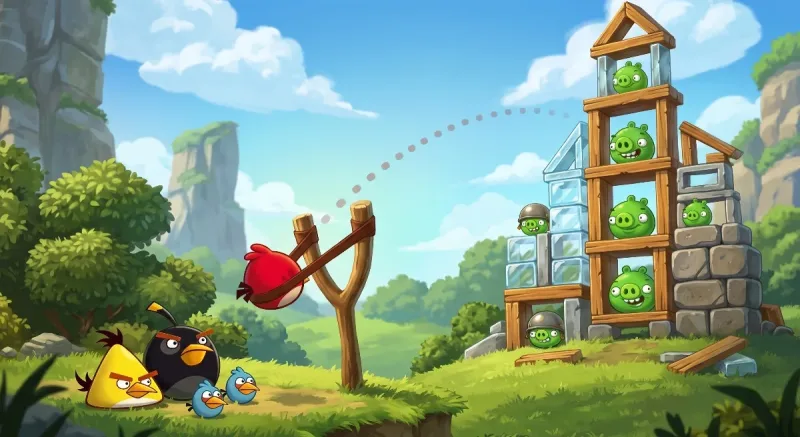
Before mobile gaming became dominated by season passes, endless countdown timers, and gacha banners, gaming on an Android phone was defined by something much simpler: pulling a virtual rubber band, releasing your finger, and watching a fortress of wooden beams crash onto smug green swine.
When Rovio launched Angry Birds on Android back in 2010, smartphones were still finding their identity. Touchscreens were transitioning from clunky novelties into everyday essentials, and everyone needed an experience that proved tactile glass could replace physical buttons. What followed was nothing short of a cultural phenomenon.
In this retrospective review, we break down why Angry Birds worked so brilliantly on Android, how its physics-based mechanics set a benchmark, where the franchise stands today, and whether it still holds up as a piece of game design.
The Hook: Why Simplicity Won the World
The plot fits neatly into a ten-second comic panel: a clan of voracious green pigs has made off with a clutch of eggs, and a motley crew of wingless, furious avians wants them back. There is no moral nuance, no deep lore, and no dialogue beyond squawks, chirps, and taunting snickers.
That simplicity was intentional. The premise gives you instant justification to do what human beings instinctively love to do—knock down towering stacks of clutter.
At its core, Angry Birds perfected the "crush the castle" physics puzzle for the touchscreen generation. By adopting the intuitive visual metaphor of a slingshot, the control scheme bypassed tutorials entirely. If you handed an Android phone running Angry Birds to a four-year-old child or a seventy-year-old grandparent, both understood within three seconds what had to be done: drag your finger back, adjust your angle, and let fly.
Gameplay Mechanics: The Art of Satisfying Destruction
While the premise was casual, the underlying mechanics were remarkably tight. Success in Angry Birds hinged on three tightly interlocking systems:
1. Intuitive Trajectory and Slingshot Physics
Pulling back on the slingshot provided tactile feedback through smooth on-screen tension. Releasing your finger sent your feathered projectile arcing through the air according to a predictable gravitational curve. After your first shot, the game left behind a faint dotted trajectory line—a deceptively brilliant design choice that turned random guessing into calculated artillery adjustments.
2. Material Dynamics: Wood, Glass, and Stone
The pigs didn’t just sit out in the open; they barricaded themselves inside architectural forts made of distinct materials:
-
Glass/Ice: Fragile, brittle, and shattering with satisfying ease.
-
Wood: Moderately sturdy, vulnerable to speed and sharp momentum.
-
Stone: Heavy, resistant to direct impact, requiring crushing structural collapses or explosive shockwaves to dislodge.
The true joy of the game wasn't necessarily hitting the pig directly. It was identifying the single load-bearing strut at the foundation of a four-story tower, snapping it, and watching the domino effect flatten everything in the blast zone.
3. A Complementary Roster of Avian Artillery
Each bird in your flock functioned as a distinct tactical tool:
-
Red: The reliable, unspecialized standard shot.
-
The Blues (Jim, Jake, and Jay): Tapping the screen splits them into a cluster shot that shreds glass blocks.
-
Chuck (Yellow): A tap grants a ferocious horizontal burst of speed, tearing cleanly through wooden beams like a buzzsaw.
-
Bomb (Black): The heavy hitter. Igniting on impact or on a delayed timer, Bomb blows fortified stone bunkers to dust.
-
Matilda (White): Drops an explosive egg bomb straight down while rocketing herself diagonally upward, enabling double-target strikes.
-
Hal & Terence: Later entries like Hal (the boomerang toucan) and Terence (the terrifyingly massive juggernaut) forced players to rethink trajectory geometry entirely.
Deciding when to trigger a bird’s secondary power in mid-flight transformed each level from a mindless catapult launch into a spatial puzzle.
Audio-Visual Presentation: Iconic Minimalism
Technically, Angry Birds never pushed Android hardware to thermal throttling, but art direction carried it further than raw polygons ever could.
The visual style relied on clean, vibrant 2D vector art. The color palette was vivid—sunny skies, lush grasslands, and moonlit deserts that popped beautifully on early AMOLED and LCD displays alike. The characters were designed with bold silhouettes: round, expressive, and brimming with personality despite having neither arms nor legs.
Then came the audio. Ari Pulkkinen’s jaunty, march-like main theme—whistling accordion, woodwinds, and percussive plucks—burrowed directly into the public consciousness. During gameplay, every action had auditory weight: the creak of the rubber strap, the triumphant screech of Chuck accelerating, the high-pitched giggle of an unharmed pig, and the popping thud of a pig evaporating into a cloud of smoke. It provided clear, immediate dopamine feedback on every single turn.
The Three-Star Loop: Casual Appeal Meets Hardcore Mastery
A basic playthrough of an Angry Birds level only required wiping out the pigs. Surviving with half your flock intact was enough to clear the stage and unlock the next one. But Rovio cleverly layered the game with an addictive scoring loop: the Three-Star Rating System.
Clearing a level with sloppy shots might earn you a measly one star. Achieving a three-star rating demanded two things:
-
Causing maximum collateral damage to the surrounding structure.
-
Saving as many birds in the slingshot as possible, with each unused bird granting a massive 10,000-point bonus.
This dynamic turned Angry Birds into an obsession for perfectionists. You would spend twenty minutes replaying a single puzzle, obsessing over a fraction of a degree in launch angle, chasing the holy grail of a "one-shot wipeout" that brought the entire fortress tumbling down. Add in hidden Golden Eggs tucked into obscure corners of the menus and levels, and the game offered dozens of hours of genuine, brain-teasing replayability.
The Evolution of the Android Port: From Standalone Classic to Modern Live-Service
Looking at Angry Birds through a modern lens requires acknowledging how dramatically the mobile ecosystem has shifted around it.
When Angry Birds initially arrived on Android in late 2010 via the GetJar store and the Android Market, it was notable for being free and ad-supported, contrasting with the paid $0.99 model on iOS. Despite occasional banner ads, it felt like a complete, self-contained game. You bought or downloaded it, you played through hundreds of levels, and your success was dictated entirely by your wits and timing.
Over the subsequent decade, mobile gaming shifted toward the free-to-play "freemium" model. Classic entries were eventually retired, delisted, or rebuilt. Modern successors like Angry Birds 2 introduced tiered spell cards, randomized multi-room stages, daily login streaks, energy/heart systems that locked you out after repeated failures, and push notifications urging microtransactions.
While Angry Birds 2 features stunning animation and dynamic weather effects, it fundamentally changed the relationship between the player and the puzzle. In the original classic, a failed level was a tactical failure you could immediately analyze and retry. In modern iterations, level layouts shift dynamically, and failing often feels engineered to nudge you toward purchasing an extra bird or a power-up.
For pure puzzle enthusiasts, this commercial evolution makes the original gameplay formula feel even more precious: a straightforward challenge that respected the player's time and skill.
Strengths and Shortcomings
| What Made It Great | Where It Showed Age |
| Physics-driven sandbox: Destruction felt physical, punchy, and dynamic rather than scripted. | Occasional physics RNG: Debris could occasionally settle in unpredictable ways, leaving a pig alive on 1 HP by sheer luck. |
| Low barrier, high ceiling: Anyone could pick it up, but three-starring later worlds required precision and planning. | Trial-and-error repetition: A few late-game stages required extreme pixel-perfect execution rather than deductive logic. |
| Timeless aesthetic: The 2D art style and character silhouettes remain universally recognizable. | Delisting hurdles: The original classic standalone version has faced removals and renamings on the Google Play Store. |
| Zero pay-to-win design: Puzzles were solved with geometry and patience, not premium currency. | Modern ecosystem bloat: Later franchise installments lean heavily into energy bars, ads, and microtransactions. |
Final Verdict
It is rare for a video game to transcend its medium and become an indelible marker of an entire era of technology, but Angry Birds on Android accomplished exactly that.
Stripping away the stuffed toys, animated feature films, and commercial licensing that followed in its wake, the underlying game remains a masterpiece of mobile design. It demonstrated how touch interfaces could provide tactile, kinetic satisfaction that a controller joystick simply couldn't replicate.
If you are fortunate enough to have the original classic in your library—or if you track down preserved versions of its earliest builds—it remains as breezy, challenging, and endlessly satisfying to fling a bird into a pile of scaffolding today as it was well over a decade ago. It is a defining chapter in Android gaming history that thoroughly earned its legendary status.



Comments
No comments yet. Be the first to ask a question or share an update.
Leave a comment
Your mobile number is never published. Comments appear after review. Website links, email addresses and code are not allowed.