
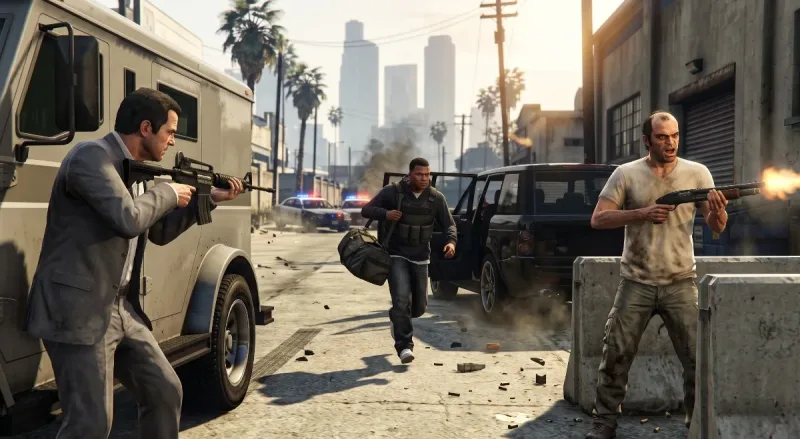
More than a decade after its original debut across console generations, Rockstar Games’ crown jewel remains impossible to ignore. Whether you are revisiting the sun-bleached asphalt of Vinewood or stepping into Southern San Andreas for the first time, writing a Grand Theft Auto V game review today feels less like dissecting a standard video game and more like analyzing a cultural landmark. It redefined open-world scope, pushed narrative boundaries with multi-character storytelling, and established an online ecosystem that outlasted entire hardware cycles.
The central question remains simple: strip away the record-breaking sales, the pop-culture omnipresence, and the endless multiplayer updates, and does the foundational single-player experience still deliver?
The Triple-Threat Dynamic
The most audacious creative gamble in Grand Theft Auto V was its decision to abandon the solitary antihero template. Instead of forcing one character to carry the weight of an entire criminal empire, Rockstar introduced three distinct protagonists: Michael De Santa, Franklin Clinton, and Trevor Philips.
Michael is a retired bank robber suffocating under the suburban luxury of Rockford Hills. Trapped in a dysfunctional marriage with kids who openly resent him, he is a man whose midlife crisis comes armed with high-caliber weaponry. Franklin offers a contemporary perspective on the classic rags-to-riches hustle, starting out as an ambitious repossession agent in South Los Santos looking for a way out of low-level gang disputes.
Then comes Trevor.
Trevor Philips is the unfiltered id of the player base personified. Living in a dilapidated trailer in the baking heat of Sandy Shores, Trevor is unpredictable, hyper-violent, and completely unhinged. Where past open-world titles struggled with narrative dissonance—forcing polite narrative protagonists to commit arbitrary vehicular homicide during gameplay—Trevor fully embraces the madness.
The mechanic that binds them together is the character switch. With the press of a button, the camera pulls high into the sky, pans across the county, and drops directly into the daily life of another protagonist. You might leave Franklin tuning a sports car at a garage, zoom over the mountains, and find Trevor waking up half-naked on a remote beach surrounded by wreckage. During structured story missions, this switching mechanic transforms firefights and escapes into coordinated tactical set pieces. One moment you are providing sniper cover from a crane as Michael; seconds later, you drop into Franklin's perspective maneuvering an escape vehicle through an alleyway.
Los Santos: A World That Breathes
The setting of Southern San Andreas is just as critical to the experience as the men pulling the triggers. Los Santos and Blaine County provide a masterclass in environmental design, capturing the distinct textures of modern California with cutting-edge fidelity.
The southern metropolitan grid hums with visual satire. Smog settles over glass skyscrapers, luxury supercars idle outside high-end boutiques, and billboards mock consumer capitalism, reality television, and tech culture. Step outside the city limits, however, and the map shifts into rugged expanses: the dusty trails of the Grand Senora Desert, the murky shallows of the Alamo Sea, and the imposing heights of Mount Chiliad.
What makes this playground work is density rather than pure land area. Pedestrians react dynamically to insults, horn-honking, and drawn weapons. Wildlife roams the rural reserves. Radio stations blend curated pop, West Coast hip-hop, classic rock, and hilariously cynical talk shows that react to events in the campaign. It is an intricate, responsive backdrop designed to reward aimless driving as much as mission progression.
Mechanics and Mayhem: How It Plays
Driving and gunplay represent significant mechanical shifts from its predecessor, Grand Theft Auto IV. Rockstar tuned the physics engine away from the heavy, boat-like handling of Liberty City toward a more responsive, arcade-inspired model. Cars grip the road with confidence, power slides feel manageable, and high-speed highway weaving offers immediate tactile gratification. Each protagonist also brings a specialized active ability to the table:
-
Franklin: Slows down time behind the wheel, making impossible sharp turns and split-second evasions effortless.
-
Michael: Enters a bullet-time state during firefights, allowing for pinpoint headshots under heavy suppression.
-
Trevor: Triggers an adrenaline frenzy that doubles his damage output while dramatically reducing the damage he takes.
Combat emphasizes a snappy snap-to-cover system paired with weapon wheels that allow seamless cycling between assault rifles, heavy explosives, shotguns, and sniper rifles. While the cover shooting does not reinvent third-person mechanics, the frantic encounter design and destructible environments keep encounters kinetic.
The undisputed gameplay highlights of the campaign are the multi-stage Heists. Rather than simply driving to a marker and shooting through a corridor, heists require groundwork. Players scout locations, choose between stealthy or loud tactical approaches, and hire support crew members whose skill levels directly impact both the mission payout and the likelihood of survival. Executing the Paleto Bay bank robbery or the daring jewelry store job represents the game operating at its peak creative rhythm.
The Double-Edged Sword of Satire
Rockstar's brand of humor has always traded in brazen, take-no-prisoners satire. In GTA V, virtually every American institution is put through the meat grinder: corrupt federal agencies (the FIB and IAA fighting for black budgets), self-obsessed social media influencers, billionaire venture capitalists, wellness gurus, and private military contractors.
For the most part, the writing lands with biting precision. Radio personalities, commercial parodies, and street encounters routinely elicit genuine laughs. However, the game occasionally confuses cynicism for substance. When every single character is fundamentally corrupt, deceitful, or reprehensible, emotional resonance can be hard to sustain.
There are narrative sequences—such as the infamous interactive interrogation sequence in the campaign's second act—where the satire feels blunt rather than clever. Yet, the voice performances from Ned Luke (Michael), Shawn Fonteno (Franklin), and Steven Ogg (Trevor) provide enough charisma and natural chemistry to anchor the story through its darker detours.
Core Strengths and Shortcomings
| Highlight Features | Lingering Flaws |
| Seamless Character Switching: Innovative multi-POV mission design that keeps pacing brisk. | Uneven Satirical Tone: Extreme cynicism occasionally undercuts narrative weight. |
| Exceptional World-Building: A stunning, diverse map packed with environmental detail. | Rigid Mission Structure: Step outside the specific mission path and you face instant failure. |
| Memorable Heist Design: Preparation, tactical choice, and high-stakes execution pay off. | Underutilized Mechanics: Certain optional activities (yoga, triathlons) feel like one-off novelties. |
The Legacy of Los Santos
It is impossible to conclude any Grand Theft Auto V game review without acknowledging the shadow cast by its online counterpart. GTA Online evolved from a rough, server-strained multiplayer experiment into an unprecedented digital empire. It kept the game continually relevant across three console generations through custom races, underground businesses, and sprawling cooperative heists.
At the same time, that runaway multiplayer success had consequences for single-player enthusiasts. Long-rumored campaign story expansions were shelved, leaving Michael, Franklin, and Trevor’s post-campaign journeys largely untouched in favor of ongoing live-service content.
Even when evaluated strictly as an offline experience, Grand Theft Auto V stands as a monumental technical and creative achievement. Its world remains a gold standard for density, atmospheric lighting, and systemic chaos. Very few games manage to capture the sheer joy of tearing down a sunlit coastal highway with the radio blaring, evading a four-star police chase, and seamlessly stepping into a cinematic bank robbery—all within the span of thirty minutes. It is ambitious, provocative, relentlessly entertaining, and remains an essential chapter in video game history.




Comments
No comments yet. Be the first to ask a question or share an update.
Leave a comment
Your mobile number is never published. Comments appear after review. Website links, email addresses and code are not allowed.